Encyclical Letter Magnifica Humanitas of His Holiness Pope Leo XIV on Safeguarding the Human Person in the Time of Artificial Intelligence The spirituality I wish to commend is that of the “wise architect” who, driven by hope for the Kingdom of God, is committed to building the world for the common good (cf. 1 Cor 3:10). As I mentioned at the beginning of this reflection, the task of building in our time must place our relationship with God at its center. Our rule must be the acceptance of human limitations as a natural and positive reality, and should be characterized by shared responsibility and a language characterized by the Gospel. At the end of this reflection, the plan for a civilization of love can be seen more clearly, and the construction site appears to be already up and running, thanks especially to the many living stones solidly united to Christ the cornerstone (cf. 1 Pet 2:4-6). In this task, we are called to assume an active role, without taking refuge in spiritual sentimentality or retreating into our own little worlds. We must be faithful to the truth, invest in education, cultivate relationships and love justice and peace. Let us remain faithful to the truth! Living amid incessant flows of information, opinions and images, we know how easy it can be to influence decisions and preferences through increasingly sophisticated algorithms. In this context, it is imperative to cultivate hearts that love the truth, prefer what is right despite the most appealing content and pursue wisdom rather than immediate results. We must always keep before us the truth about God and humanity, just as Christ has revealed them to us. We must lay aside an individualistic and technical view of humanity, as if reality were mere matter to be shaped according to selfish interests, whether individual or collective. Instead, let us cultivate what Pope Francis called a “situated anthropocentrism,” which recognizes the human being as a creature embedded in a network of relationships with other living beings and with all of creation. Fidelity to the truth requires integrating the possibilities offered by technology within a framework marked by wisdom, which is capable of safeguarding both the dignity of each person and the future of our common home.
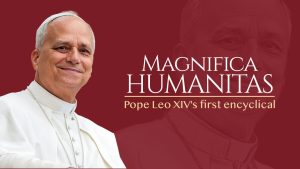
Encyclical Letter Magnifica Humanitas of His Holiness Pope Leo XIV on Safeguarding the Human Person in the Time of Artificial Intelligence
Published on July 12, 2026